

Site Selection Best Practices for Franchise Growth
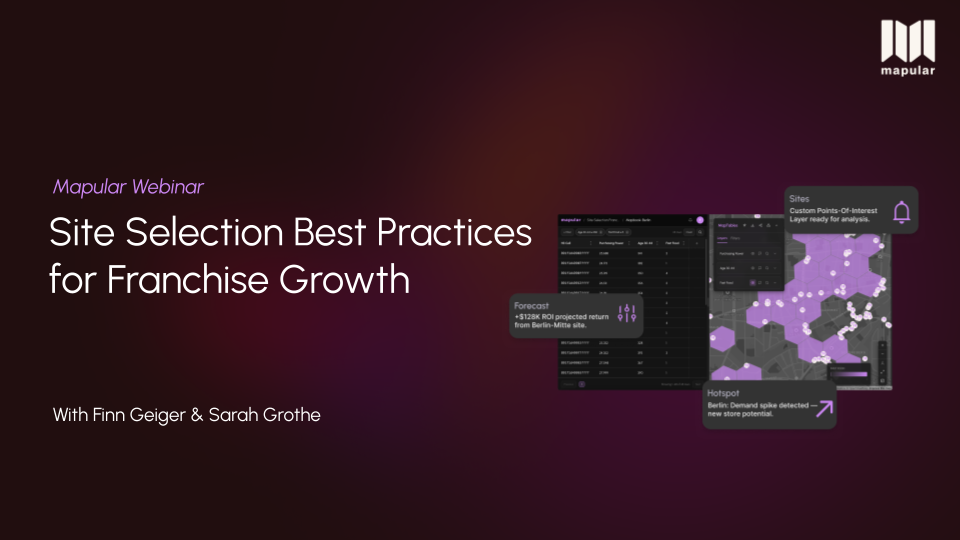
Webinar: Site Selection Best Practices for Franchise Growth
Recap of our webinar series “Site Selection Best Practices for Franchise Growth“: watch the replay here: Youtube.
Site Selection Best Practices for Franchise Growth: A 4-Step System to Standardize Decisions
Site selection needs process and discipline. Real estate mistakes can stay for years, unlike changes in marketing, pricing, or team structure.
A standardized workflow reduces opinion-based debates, improves comparability across sites, and creates transparency for management, headquarters, partners, and brokers.
Why Franchise Site Selection Workflows Need an Update
Expansion workflows often stay unchanged for years. That creates risk because:
- Regional dynamics shift
- Audiences change or move
- Yesterday’s best market may no longer be today’s best market
A repeatable playbook supports faster decisions, reduces internal friction, and helps prevent self-competition (cannibalization).
The 4 Questions That Standardize Franchise Site Selection
A practical site selection playbook answers four questions in order:
- What is a good location for the format?
- What inputs are trusted, and how are they made comparable?
- Where can growth happen without hurting existing units?
- How can decisions run at scale across multiple team members?
A useful framing for success is the match between concept, real estate, and operator. If one factor is weak, even a good location can fail.
Step 1: Define What a “Good Location” Means for the Format
A “good location” depends on the operating model. Site selection is not only choosing a place; it is choosing the right format for that place.
Example: QSR (Quick Service Restaurant) Location Profile
Common components:
- Catchment based on travel time
- Customers live within travel time, not within a postcode boundary. A fixed driving-time rule supports consistent evaluation.
- Clusters matter
- Food decisions often happen where food options concentrate, for example malls and food courts. Being outside the cluster can reduce conversion.
- Logistics and access are non-negotiable
- Deliveries, access, parking, and rider flow can determine throughput.
Example: Fitness Location Profiles
Fitness often splits into different formats with different location needs.
Micro gyms (small footprint)
Often prefer B locations, near pedestrian zones but not necessarily inside prime retail streets. Lower rent and faster setup reduce investment risk and create a real exit option if the site is wrong.
Multi-format networks
Win by matching formats to market and available units.
Simpler personalized formats can work in smaller towns.
EMS studios can work in dense areas with different demand patterns.
Premium and discount formats serve different segments and price sensitivity.
Step 2: Make Locations Comparable With a Territory Pack
A territory pack keeps evaluation organized and comparable across locations and people. It is a franchisor tool, not a broker deliverable.
What a Territory Pack Contains
A territory pack is a consistent snapshot of a site’s surrounding reality. It standardizes evaluation across regions and avoids comparability breaking at administrative boundaries.
Core elements:
- Boundary logic
- A fixed rule such as a 10-minute travel-time catchment.
- POIs and competitive context
- Competitors and anchor stores that matter for the format.
- Target context
- Population, relevant age bands, purchasing power.
- Site visit checklist
- Prepared visits reduce “vibe checks,” personal bias, and overconfidence.
Add Internal Signals (First-Party Signals)
Perfect data is not required. Consistent and explainable signals are required.
Three internal signal types:
- Demand signals
- Orders, reservations, delivery areas, membership signups by area.
- Attention signals
- Where online campaigns work, for example Google Ads or Meta.
- Intent signals
- Store locator usage, newsletter clicks, CRM insights such as Klaviyo data.
These signals help translate where pull exists, meaning customer intent, and where push should be placed, meaning presence and expansion.
Step 3: Grow Without Hurting Existing Units
Preventing self-competition requires upfront rules and consistent application.
Decisions to Set Upfront
- Overlap tolerance
- How much overlap between locations is acceptable.
- White space detection
- Spot gaps early to place new sites intentionally.
- Planned density vs accidental overlap
- Separate deliberate network density from unplanned cannibalization.
- Territory discipline
- Buying territory without a development plan becomes a liability at scale.
Two Practical Overlap Rules
QSR: Sales overlap review triggers
If catchments overlap beyond a defined percentage, the site needs review.
If delivery zones overlap beyond a defined percentage, either demand supports multiple locations or the site needs review.
Fitness: Capacity overlap as demand relief
A second site can improve network performance when an existing location hits a consistent member threshold and service quality needs protection.
Step 4: Run Decisions at Scale With a Documented Workflow
Speed matters in commercial real estate. Waiting can cost a site. A scalable workflow reduces slow committee cycles and supports parallel work during due diligence.
A Take-Home Checklist for Scalable Site Selection
- Intake
- Standardize incoming site information and store it in a consistent packet.
- PreCheck
- Apply the same kill criteria across the team:
- Same catchment definition
- Same overlap threshold
- Non-negotiables verified
- Score
- Build a scorecard using:
- Territory pack
- First-party signals
- Decision
- Approve, reject, or dig deeper, with documented reasons supported by data rather than gut feeling.
- Feedback loop
- Compare expected versus real outcomes and adjust the playbook as the network scales from early locations to hundreds.
- Documentation increases transparency for management and partners and makes the process reusable.
Key Takeaways
Site selection requires a standardized playbook because real estate decisions have long-lasting consequences.
A four-question workflow creates repeatability: define the format, standardize inputs, control overlap, and scale decisions.
Consistent territory packs and first-party signals improve comparability and decision quality.
Overlap rules and upfront tolerance prevent accidental cannibalization.
Documentation creates transparency and enables continuous improvement through feedback.
What Mapular Is and How It Supports This Process
Mapular is a location intelligence platform built specifically for franchise and multi-location brands.
It turns the 4-step framework described above into an operational, scalable workflow. Instead of managing site selection in scattered spreadsheets and subjective discussions, teams can run a structured process across regions and formats.
With Mapular, expansion and real estate teams can:
- Create standardized travel-time catchments for every site
- Generate consistent territory packs with demographic, purchasing power, and competitor data
- Integrate first-party signals such as store locator usage, CRM data, and campaign performance
- Define and apply overlap rules to control cannibalization
- Score and document decisions across multiple team members
- Export structured one-pagers for management, partners, and investment committees
The goal is simple:
Make site decisions transparent, comparable, and scalable, without requiring GIS expertise or external consultants.
Mapular helps franchise networks grow with discipline, clarity, and repeatable decision logic.
Watch the Webinar Recording
If you would like to see the full walkthrough, including live examples, scoring logic, and practical franchise cases, you can access the complete recording here:
Watch the webinar recording and access the slides


